
Jeudi 26 mars de 14h00 à 15h30
Amphi Ircica – 50 avenue Halley – Haute Borne – Villeneuve d’Ascq
Abstract: Neural Fields, or Neural Implicit Representations, have become a cornerstone of visual computing and beyond, offering ompact and expressive continuous representations. Among them, Neural Radiance
Fields (NeRFs) have transformed how we model and reconstruct 3D scenes. Yet their expressivity comes at a high computational cost, which still hinders real-time rendering at high quality. To overcome this
limitation, we introduced 3D Gaussian Splatting, which takes a complementary, explicit approach: scenes are represented as mixtures of millions of Gaussian primitives. This enables efficient, splatting-based
rendering with high image quality – but at the expense of flexibility and memory efficiency, due to the rigid analytic form of the primitives. I will present a new scene representation based on Splattable Neural
Primitives, which merges the strengths of both worlds: the expressivity and compactness of neural fields with the rendering efficiency of primitive splatting. This approach balances quality, performance, and
memory, and demonstrates that the two approaches need not be treated as mutually exclusive.
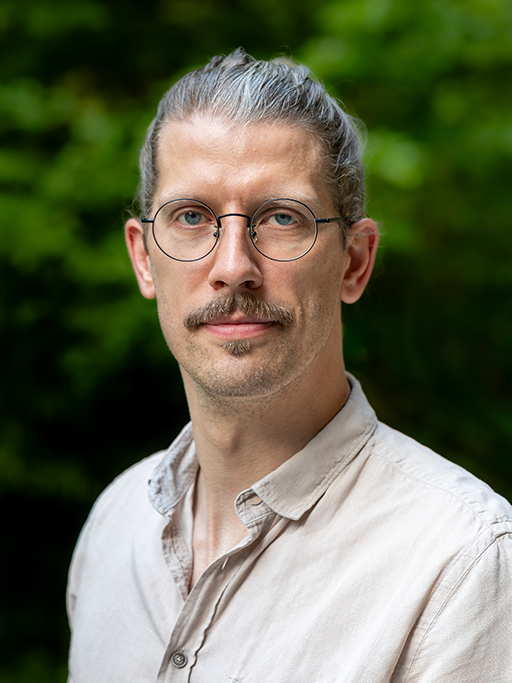
Bio: Thomas Leimkuehler is a senior researcher and research group leader at the Max Planck Institute for Informatics, Germany. His research lies at the intersection of visual computing and machine learning, with special interests in neural signal representations, generative models, rendering of all flavors, and efficient parallel algorithms. Prior to his current position, Thomas was a postdoctoral researcher at Inria
Sophia-Antipolis, France, following the completion of his PhD at MPI Informatik. Thomas is a recipient of a Eurographics PhD Award, the Otto Hahn Medal of the Max Planck Society, a Eurographics Junior Fellowship, and several best-paper awards.